Hello,
Frances remembers when you left
the tears dropped in her oatmeal.
Frances wanted to follow the tracks you made
she was angry when i wouldn't let her.
Frances slept with your shirt tonight
she thought that she could smell you.
You should call Frances
she needs to hear your voice.
Frances took down all your pictures
she put them in a box.
Frances didn't want to go to school today
she hoped that you would take her.
Frances tried to call you
the number didn't work.
Yesterday, Frances was in a play
I saw her check the crowd for you.
Frances got her ears pierced
she didn't mention you.
it was Frances' birthday
she kept checking the mail.
Frances kissed a boy today
i don't think she wanted you to know.
Frances fell in love
she wanted to ask you a question.
the boy Frances was with left
she said he was just like you.
Frances graduated today
i thought you'd like this picture.
Frances moved into her dorm
you were nowhere on her mind.
Frances has been thinking a lot
she wondered where you were.
Frances bought a car
she asked some guy to help her.
Frances got her masters
she went somewhere for a job.
Frances moved back in
she wanted to be close.
Frances saw me writing this
she said that i should stop.
Frances met a boy
she said he's not like you.
Frances got a ring tonight
she's planning her new life.
Frances didn't want to go down the aisle
she thought that you would call.
Frances' husband bought a house
they want to start a family.
Frances said you're not invited...
i guess that's all,
um, you can write if you want.
Sunday, August 16, 2009


Monday, August 10, 2009
Series Review: Harry Potter and the Author Who Didn’t Know When to Stop

You're going to hate me now...
click on images for sources
For more than 10 years the world has been suffering from Harry Potter mania. In 1997, J.K. Rowling released the first Potter book. Today, with books, movies, video games and other merchandise, the Harry Potter brand is now worth $15 million (exchange4media). Rowling’s seven books have been translated into 64 languages and sold over 375 million copies (Glovin). She is now the highest earning novelist in history, a history that has included the likes of Charles Dickens, Oscar Wilde and C.S. Lewis and for that I have to respect her. But 4,126 long pages after I opened the first installment of Harry Potter to when I closed the last book, I still have no idea why the series has became a worldwide phenomena. It’s just not that good.

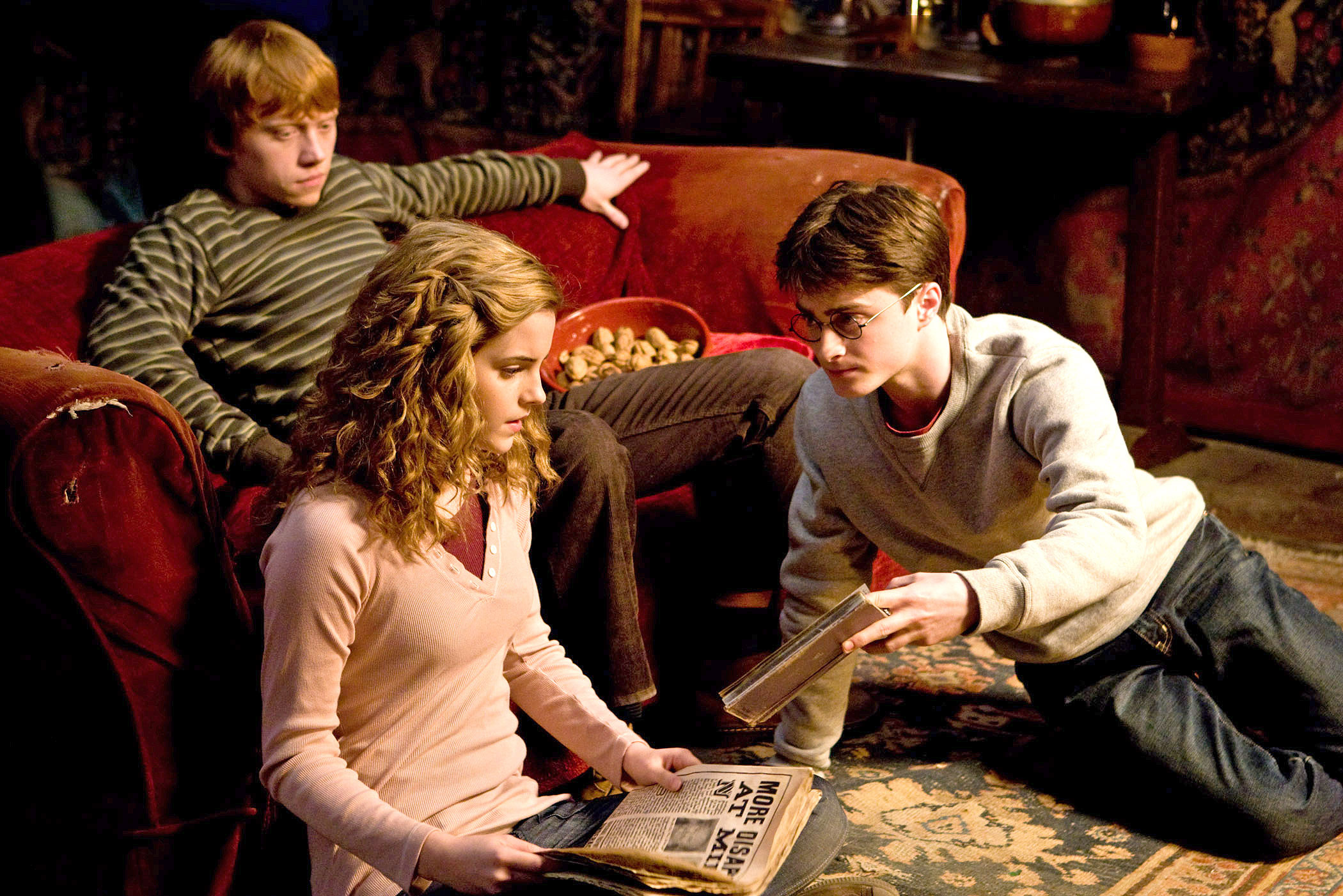
Yet, even with all of these shortcomings the entire plotline of all seven books isn’t bad at all. It’s entertaining and simplistic, you can enjoy it without having to put very much thought into it, it’s literary fast food. The problem with fast food is that too much makes you sick and Rowling doesn’t seem to understand this. Several hundred of her 4,126 pages are not only pointless but also boring. She could have told the same story much more effectively in half that number pages.

Rowling not only violates the less-is-more guideline of writing by also the show-don’t-tell rule. After the release of the final Potter book, Rowling made an announcement that came as a surprise to many fans- Harry’s mentor and one of the main characters, Dumbledore was gay and had a love affair (Siegel). Once a book is published a writer shouldn’t be able to announce parts that she neglected to actually write in the books. A series like Harry Potter needs to be a complete world on its own, just as The Chronicles of Narnia and The Lord of Rings are. If anyone can read more than four thousand pages of a seven book series and not know that one of the main characters is gay and lived a full, but secret, life then the writer of those pages has not done her job.
Oh, and just in case this essay isn’t clear, it was supposed to be about how Harry Potter is actually a great literary work, I just neglected to mention that.
Works Cited
1. Exchange4media.com. International: Harry Potter, the $15 Billion Man. 5-26-08.
http://www.exchange4media.com/kids/KidsFullStory.asp?news_id=26820&tag=21718. 7-16-07
2. Glovin, David. Rowling Warns of Potter Plagiarism in Trial Testimony (Update4). 5-26-08. http://www.bloomberg.com/apps/news?pid=20601102&sid=aR2uXKyRcjAQ. 4-14-08.
3. Bristow, Jennie. Harry Potter and the Meaning of Life. 5-26-08. http://www.spiked-online.com/Articles/00000006DE0C.htm. 6-19-03
4. Siegel, Hanna. Rowling Lets Dumbledore Out of the Closet. 5-26-08. http://abcnews.go.com/Entertainment/story?id=3755544. 10-20-07
Sunday, August 9, 2009
A Community in Harmony
“Don’t interrupt Mommy while she’s on the phone…Leave the kitchen please…Excuse me, my kids just left the house,” Jackie Shannon, adjunct professor at the California State University, Dominguez Hills, said as she put down the telephone to round up her two sons, ages 3 and 5.
Besides teaching music at the university and keeping an eye on her boys, Shannon still finds time to practice her skill on the French horn for up to three hours everyday and play in several community orchestras including the Carson-Dominguez Hill Symphony Orchestra.

photo from the City of Carson
Since 1972, musicians of all ages and from all walks of life have been joining together to form the Carson-Dominguez Hills Symphony Orchestra.Even though Carson is most famous for having its politicians arrested and its council meetings broadcasted on YouTube, the semiprofessional community orchestra has also made a name for itself by winning the National Recreation and Park Association Arts and Humanities Award.
The orchestra has come a long way in its 35 years.
Les Woodson, a tuba player who has been with the orchestra from day one, said when they played their first concert, in October of 1972, they weren’t very good at all.
“There was a guy who wanted to start an orchestra…He had a big ego,” Woodson said of the orchestra’s first director, whose name he couldn’t even remember.
It wasn’t until 1975, when Frances Steiner, professional cellist, conductor, and adjunct professor at the California State University, Dominguez Hills took over as director that the orchestra started to improve, Woodson said. “(The orchestra) would not have survived,” he said.
It was under Steiner’s direction that the initially city-funded orchestra combined with the California State University, Dominguez Hills to become the Carson-Dominguez Hills Symphony Orchestra. The 50 to 60 members of the orchestra get paid a stipend ranging from $150-$200 per show.
Through the partnership, the orchestra gives university music students the opportunity to perform with seasoned professional and semiprofessional musicians, Hector Salazar, trombone player and assistant conductor for the orchestra said.
Salazar has been in the Carson-Dominguez Hills Symphony Orchestra for 20 years. He has been playing the trombone since middle school and he now teaches music and conducts professionally.
“Community regional orchestra is really important…They offer concerts to people who can’t afford to go to the philharmonic,” Salazar said.
Every year the orchestra puts on at least five concerts for the Carson-Dominguez Hills community, which include two evening concerts and three children’s concerts. They rehearse only five times before each show. Both students and community members are glad to have an outlet for their musical talent.
Shannon, a former professional musician, who now teaches music at the California State University, Dominguez Hills, and gives private lessons, said performing with her students helps her connect with them and reach out to the community through her music.
Shannon has been playing the French horn ever since elementary school, when she said she literally heard the instrument calling to her.
She said she remembers going to the school gym to hear a sampling of all of the instruments available at the school. It was the day when she was supposed to pick what instrument she was going to play for the school band. Before she even saw the instruments, she had already chosen.
“I heard this beautiful sound and I said I want to play that instrument,” Shannon said.
Shannon, whose husband plays trombone for the Beach City Sling Band, is already preparing her children to follow in their parents musical footsteps. Since her sons were 6-months-old, they have been taking piano and Orff music lessons. In Orff lessons, young children are introduced to music, especially percussion instruments.
Even though Shannon said Orff is basically a parent tapping rhythms on their baby’s back, she said she it gave her kids a goods sense of rhythm.
Meanwhile, Steiner, whose mother was a professional violinist and father a professional cellist, said it was never important to either marry a musician or push her daughter into music.
Since she was 15-years-old Steiner has been performing professionally; she started taking lesson at age 5. By age 21, she was a fulltime professional cellist. She has performed with orchestras on both the East and West coasts including at the Kennedy Center and the Los Angeles Art Museum. However, she decided that the life of a professional musician wasn’t for her and instead went on to study at the University of Southern California, Harvard University, Temple University, and several music schools in France, New York and Vermont.
“It was a competitive lifestyle…somewhat political,” she said of her life as a professional musician.
“I opted very early to teach and play,” said Steiner who, besides teaching at the university, also directs the Chamber Orchestra of South Bay and the Southwest Youth Music Festival Orchestra along with the Carson-Dominguez orchestra. She still finds time to practice the cello.
For many, being part of the Carson-Dominguez Hills Symphony Orchestra meant finding a place where they could keep their musical skills in tune.
“I always looked for opportunities to perform. I was determined when I got out of college to not forget my music like so many other people I knew,” Tuba player Les Woodson said.
Woodson, who is a financial advisor, started playing the tuba in high school.
His father was also a musician who played the violin and the piano and finished fourth in an international competition for barbershop quartets. His mother played the piano and his siblings sang in a choir. When Woodson was a child, his parents made him take piano lessons but he never enjoyed playing music until he found the tuba.
After high school, during the first years of the Vietnam War, he joined the National Guard Band. Woodson thanks the tuba for keeping him out of Vietnam.
“Tuba saved my life,” he said repeatedly. Woodson, who doesn’t live in Carson, drives 85 miles from his home in Crestline just to perform with the orchestra.
Woodson isn’t the only musician who goes out of his way to be a part of the orchestra. Joe Jackson, a tuba player for the Carson-Dominguez Hills Symphony Orchestra as well as a professional musician, music teacher, and steam train engineer for Disneyland also makes an effort to play with the group, which he’s been with since 1996.
“It’s really hard to juggle and sometimes I don’t juggle as well as I should. It really comes down to picking and choosing,” Jackson said.
Even with his multiple jobs and his wedding coming up in February, Jackson
makes time to practice from one to four hours a day.
He’s been playing tuba since middle school.
“I always liked things that were big. I saw the tuba and I was really impressed by its size,”
Jackson said. He went on to major in tuba performance at the University of Southern California.
Now, however, he said it’s the tuba’s sound rather than its size which keeps him interested. He often performs tuba solos for the Carson-Dominguez orchestra and freelances for other orchestras.
“I really enjoy solos, that’s really when I’m the happiest,” Jackson said.
Even if they have little else in common, for Jackson and the other members of the orchestra, it’s the love of music and the happiness they get out of it that bonds them together.
“I wouldn’t do it if I didn’t love it,” Shannon said.
Whatever they are in the rest of their lives-students, teachers, theme park steam train conductors, financial advisors, computer technicians, mother, fathers, sons and daughters, when they come together as the Carson-Dominguez Hills Symphony Orchestra, they’re all musicians.
“Orchestra is like a sense of family,” Salazar said.
Gilbert Smith

click on photo to see its source
In 1968, Smith was the city’s first councilman, then its third mayor from 1970-71 and again from 1974-75. He was later councilman until 1980 and city manager in 1998. Smith is also one of the founders of California State University, Dominguez Hills, from which he received an honorary doctorate last May.
“If you compare the Carson of 1968 with the Carson of today, it’s like night and day,” said Smith who, as a child, used to pay fifty cents for horse rides in the undeveloped Carson land.
Back in 1963, he and his first wife, Glenda, were living in a 40-year-old, house in Los Angeles. They wanted a bigger house to raise their three sons.
It was a hard search.
Smith, an African American, said that at almost every housing sales office, the salespeople would say they were closed or sold out. Sometimes they would say they couldn’t sell them a house.
“‘There is a problem with the color of your skin,’ literally those were the words,” Smith said, “It was the general climate at that time in the state of California.”
Once, a salesman told him that he didn’t believe in discrimination but it was company policy, Smith said. With “tears running down his face” the salesman tried to offer him a house that was in a location he wasn’t interested in.
The Smiths were finally able to buy a home in the area that would be Carson. The four-bedroom, two-bathroom, house cost $25,000, it wasn’t even built yet.
The first time they drove up to their new home, it was surrounded by a group of mixed-race picketers calling for a boycott of the racist housing companies.
The family soon realized that the area needed a lot of work. There were 23 dumping sites, more than 100 wrecking yards, no sidewalks, no shopping center, five oil refineries, and three chemical companies around the developing residential area, Smith said.
The community had been pushing for incorporation since the 1950s, the goal was accomplished in 1968, under Smith.
As president of his homeowners association, Smith was elected the first chairman of the citizen’s organization for the incorporation of Dominguez-Carson, later named Carson.
“I didn’t know they were going to elect me, I guess I had the biggest mouth,” Smith said.
The city began with only 63,000 residents, today it has almost 100,000. Smith said they were proud to be a diverse community from the very beginning.
In the first two years after incorporation, they planted more than 5,000 trees in the once barren land. Smith’s first $25,000 home recently sold for almost $600,000.
“It’s truly a blessed city,” Smith said.
Now, 40 years later, Smith is still involved with Carson’s politics,
“It should have been part of this city 40 years ago,” he said about the proposed annexation of the Rancho Dominguez area. It was included in the proposed 1968 boundaries, but political problems prevented it from being annexed. Smith said he thinks, if city can afford it, the proposal should be accepted.
Recently, the group supporting the recall of Mayor Dear asked Smith, who ran against Dear in 2005 to run for mayor again. Smith said, if the recall goes through, he will run again.
“This is my city, I live here,” Smith said.
Babe’s and Ricky’s Inn

from Babe's and Ricky's Inn website
It’s almost 10 O’clock, on a Monday night, and the street outside is quiet. But inside the door, which is just a little hole in the wall, life is teeming.
Like some kind of forgotten anthill or left over from the golden age of the Big Easy the legendary blues club, Babe’s and Ricky’s Inn, on Leimert Boulevard, still flourishes underground.
 from Babe's and Ricky's Inn website
Like a queen with a bright purple beret of a crown, founder Laura Gross, 88, sits just inside the door adjusting the cover charge from $8 to $10 as she runs out of change. For 44 years, and two locations and the threat of bankruptcy, Gross has reigned over Babe’s and Ricky’s with an iron rule.
The mirrors along the back wall make the room seem bigger and fuller than it really is. Not that it isn’t full, people are lined up against the bar and almost every seat is taken. The crowd is a mix of college students looking for an old-school experience and middle aged patrons for whom this is probably a regular hangout.
The big red pleather booths are occupied by people just starting to feel the effects of their alcoholic beverages.
On stage, several bands play in succession. They’re good, but not what you’d expect for a blues club where legends like B.B King used to perform. Amateurs and greats alike still play here.
The musicians tonight are mostly young white males, but they’ve got soul. Some are eccentric, following in the modern “emo” style of young bands they are dressed in black, or skinny jeans, with hair just covering their eyes having perfectly mastered the look of socially competent “geek“, meanwhile one older artist expresses himself in a bright red sequined scarf.
There is a list by the door where musically talented club-goers can sign up to play the instrument of their choice.
A college student in a black and white striped shirt steps onto the stage for a turn on the drums. He is announced as a recently freed jailbird, the announcer enjoys the joke more than the crowd.
The drummer plays with the attitude of an entertainer, pulling faces, bopping to the music. It’s clear he’s played for crowds before and enjoys it. Every time he hits the drum the light reflected in it jumps to the rhythm of the music.
The other college students are cheering for him, whistling. Some are his friends, some are feeling their drinks. He’s good though, the job offers he gets when he steps down are proof of that.
Around 11p.m. dinner is served. From the back of the club, no announcement can be heard but word spreads and a lazy S-shaped line is formed from the front to the back.
You can serve yourself from dishes of collard greens, black-eyed peas, and potato salad, but two strict looking women, one of them Laura Gross, serve only one slice of hot link sausage, one piece of fried chicken, and one fried corn biscuit per person. It’s Jam Night so the meal comes with your cover charge. The regular menu has only three options, chicken wings, hot links, and fried fish.
You can order drinks all night, you may not get exactly what you ordered, but you’ll drink it anyway. The food is taken back to tables decorated with plastic white doilies and red, white and blue flowers.
The flowers match the dark red walls, covered with old photos and posters, and the blue Christmas lights, and the partly deflated red, white and blue, balloons that look like they’ve been left behind from some 4th of July celebration a decade ago. Somehow, it just escapes being tacky.
From the corner of the middle wall, an old Central Avenue street sign juts out, reminding customers of the club’s first location. You know this place has history, even if you don’t know it.
As people finish eating they slowly trickle out. They come as much for the food as the atmosphere and music. Gross has something to say to everyone. She tells some college girls not to get fat and she tells the jailbird drummer to put on some weight.
It’s just about midnight and Babe’s and Ricky’s Inn is dying down, strange for a Los Angeles night club, but maybe not so strange for a bustling blues club left over from the 60s.
Saturday, August 8, 2009
WRESTLING AND SHAKESPEARE AN INTERVIEW WITH SEAN LEWIS -one of the very first interviews I ever did (summer 2005)
A Lucentio of sorts, Sean Lewis may or may not have a romantic love interest but he is definitely in love with theater. You can hear the passion in his voice as he describes his journey from wrestling to becoming a successful actor, playwright, and producer of his own one man show.
Lewis, at age 26, has been acting for four or five years, he’s not sure. Originally from Pine Bush, New York he went to college at the State University of New York in Binghamton, New York. He had a wrestling scholarship until an injury ended his athletic career. In an attempt to get back in shape for wrestling, Lewis attended a movement class taught by an acting teacher. His teacher encouraged him to try out for Romeo and Juliet, where he scored the part of Lord Capulet. Before the part he had had no history in theater. Lewis says he “felt really lucky” and ever since then, theater has been the love of his life.
Initially Lewis says “Most of my family was like, ‘What the hell is wrong with you?’” and ‘Stop messing around and get a job!’” but eventually they came around. To Lewis, it never really mattered what others thought: “I’ve always been the guy who did what I wanted and the rest of the family was left scratching their head.” Well, Lewis’ life proves that he knows what he’s doing.
Recently Lewis has begun sending out his play Forrestry, to theaters who might be interested in producing it. The play is the story of Edwin Forrestry, who is said to be America’s first celebrity. It is the story of Forrestry’s life as an actor in the 1800’s. One of the interesting events of the play is a riot brought on by a competition between Forrestry and competing English actor Maccready that became so crazy that the National Guard was called in to put it down. Lewis found the inspiration for this play while sitting in a fellow playwright’s house and flipping through a text book. The text book featured a picture of Forrestry whom Lewis thought “looked like a wolf man”, he became so fascinated by this actor and his acting style and life that it prompted him to write a play.
Another high point of Lewis’ life is his one man show based on character Sean Boogie, a name that originated from Lewis’ own nickname “Boogie”. The show is about a young white male who enjoys rap music and hip-hop and his encounters with a well- educated black professor. The play, which contains 15-20 characters all played by Lewis, deals with society’s portrayal of what it means to be “black”, and jokes about the idea of putting labels on race. For a long time before he actually wrote the play, Lewis had been toying with the idea of a one man show until one day a theater called him up and asked him to perform it. Even though Lewis had nothing prepared he said yes. The actual idea for the show came from a series of connections Lewis found while going threw his own slam poetry; before that he had no “blueprint” of what he would do. He will be doing a show this coming March from the 2nd-4th at the riverside theater, where he is also in the productions of Taming of the Shrew as “Lucentio, the young lover” and Moliere’s The Imaginary Invalid playing from June 17th-July 10th. While looking in his backpack for the dates, Lewis comments that he is always scatterbrained and just found out about this night’s rehearsal this morning as he pulls random articles and papers out of his bag.
Throughout the whole interview his love for theater broadcasted loud and clear and I’m sure that Sean Lewis is destined to make his mark on the world of stage. During the end of the interview however, Lewis gave me his outlook on the ups and downs of acting. He says it’s like “making an agreement with the audience” “I’m asking them to believe.” He also says that it’s “such a joy for me.” He only wishes that more young people today would be interested in theater. I also asked him about his pre-show routine and he answered that it involved some stretching, vocal exercises, and running around, but that he doesn’t think about the show itself “some actors need to think about it, I need to not.” He says he’s been in a lot of good productions as well as some bad ones, and when you’re in a bad one it’s like “I just don’t want to be on the stage right now…(but) I might as well try and entertain someone.” Lewis also mentions that the rejection of not getting a part can be hard “and not getting it (the part), it’s like...you’re killing me, you’re killing me slowly,” and that there is a lot of competition involved “the acting profession can be like high school...Catty.” Another thing that he made clear is that the moving and traveling with the cast can be rough also, “If you have a really cool cast and you’re in a really cool city it can be great…But when you’re surrounded by bad people it’s like, enough of this I want to go home.”
Lewis, at age 26, has been acting for four or five years, he’s not sure. Originally from Pine Bush, New York he went to college at the State University of New York in Binghamton, New York. He had a wrestling scholarship until an injury ended his athletic career. In an attempt to get back in shape for wrestling, Lewis attended a movement class taught by an acting teacher. His teacher encouraged him to try out for Romeo and Juliet, where he scored the part of Lord Capulet. Before the part he had had no history in theater. Lewis says he “felt really lucky” and ever since then, theater has been the love of his life.
Initially Lewis says “Most of my family was like, ‘What the hell is wrong with you?’” and ‘Stop messing around and get a job!’” but eventually they came around. To Lewis, it never really mattered what others thought: “I’ve always been the guy who did what I wanted and the rest of the family was left scratching their head.” Well, Lewis’ life proves that he knows what he’s doing.
Recently Lewis has begun sending out his play Forrestry, to theaters who might be interested in producing it. The play is the story of Edwin Forrestry, who is said to be America’s first celebrity. It is the story of Forrestry’s life as an actor in the 1800’s. One of the interesting events of the play is a riot brought on by a competition between Forrestry and competing English actor Maccready that became so crazy that the National Guard was called in to put it down. Lewis found the inspiration for this play while sitting in a fellow playwright’s house and flipping through a text book. The text book featured a picture of Forrestry whom Lewis thought “looked like a wolf man”, he became so fascinated by this actor and his acting style and life that it prompted him to write a play.
Another high point of Lewis’ life is his one man show based on character Sean Boogie, a name that originated from Lewis’ own nickname “Boogie”. The show is about a young white male who enjoys rap music and hip-hop and his encounters with a well- educated black professor. The play, which contains 15-20 characters all played by Lewis, deals with society’s portrayal of what it means to be “black”, and jokes about the idea of putting labels on race. For a long time before he actually wrote the play, Lewis had been toying with the idea of a one man show until one day a theater called him up and asked him to perform it. Even though Lewis had nothing prepared he said yes. The actual idea for the show came from a series of connections Lewis found while going threw his own slam poetry; before that he had no “blueprint” of what he would do. He will be doing a show this coming March from the 2nd-4th at the riverside theater, where he is also in the productions of Taming of the Shrew as “Lucentio, the young lover” and Moliere’s The Imaginary Invalid playing from June 17th-July 10th. While looking in his backpack for the dates, Lewis comments that he is always scatterbrained and just found out about this night’s rehearsal this morning as he pulls random articles and papers out of his bag.
Throughout the whole interview his love for theater broadcasted loud and clear and I’m sure that Sean Lewis is destined to make his mark on the world of stage. During the end of the interview however, Lewis gave me his outlook on the ups and downs of acting. He says it’s like “making an agreement with the audience” “I’m asking them to believe.” He also says that it’s “such a joy for me.” He only wishes that more young people today would be interested in theater. I also asked him about his pre-show routine and he answered that it involved some stretching, vocal exercises, and running around, but that he doesn’t think about the show itself “some actors need to think about it, I need to not.” He says he’s been in a lot of good productions as well as some bad ones, and when you’re in a bad one it’s like “I just don’t want to be on the stage right now…(but) I might as well try and entertain someone.” Lewis also mentions that the rejection of not getting a part can be hard “and not getting it (the part), it’s like...you’re killing me, you’re killing me slowly,” and that there is a lot of competition involved “the acting profession can be like high school...Catty.” Another thing that he made clear is that the moving and traveling with the cast can be rough also, “If you have a really cool cast and you’re in a really cool city it can be great…But when you’re surrounded by bad people it’s like, enough of this I want to go home.”
untitled 2 (from several years ago)
Funny all the people we meet
On a crowded street
They all have places to go
They don’t even know
They just bumped into an old pal
Slipped into their old gal
Knocked down the teacher that taught them 1, 2, 3.
Tripped over the hero
That they used to want to be.
Funny we don’t see the faces or use those simple graces
Like hi, hello, and please, thank you
You don’t even remember what or when or who
All those memories of the past
‘Cause you’re moving just too fast
Maybe if you slowed down
And took a look around
You’d notice all the old friends that you forgot to see
And all the old dreams that you forgot to be.
On a crowded street
They all have places to go
They don’t even know
They just bumped into an old pal
Slipped into their old gal
Knocked down the teacher that taught them 1, 2, 3.
Tripped over the hero
That they used to want to be.
Funny we don’t see the faces or use those simple graces
Like hi, hello, and please, thank you
You don’t even remember what or when or who
All those memories of the past
‘Cause you’re moving just too fast
Maybe if you slowed down
And took a look around
You’d notice all the old friends that you forgot to see
And all the old dreams that you forgot to be.
untitled 1
We are all ugly at birth
Crumpled faces, dirty
Mothers make us beautiful
Fathers reinforce it
Little nobodies
Future some bodies
Some will grow to greatness
Some will fall obscure
We will die beautiful
We will die ugly
They will cry
They will laugh
Maybe…
They won’t know
Thrust and heat of life
Cold and static death
Climax, rest, relax, repeat
Sound familiar?
Crumpled faces, dirty
Mothers make us beautiful
Fathers reinforce it
Little nobodies
Future some bodies
Some will grow to greatness
Some will fall obscure
We will die beautiful
We will die ugly
They will cry
They will laugh
Maybe…
They won’t know
Thrust and heat of life
Cold and static death
Climax, rest, relax, repeat
Sound familiar?
Washed Away (early teens)
A hunk of clay raw and uneven
I take it with my hands.
It’s soft and pliable.
Into it I pour my dreams, hopes
My time, my soul, my life.
It begins to form a face
Strong and wise
With piercing eyes.
A body firm and flowing
It’s the picture of perfection.
My life’s work
It’s everything I aspired for
Desired for.
I put it in the sun to dry
To harden forever the likeness of my mind.
Alas! The weather is unpredictable.
A storm refuses not to blow
The wind howls, the rain blasts
My perfect statue, my Mona Lisa, my David.
Gone! All washed away
A trickle in the mud of alabaster clay.
I gather what’s left, I cry
For what was there, now gone.
A hunk of clay raw and uneven
I take it with my hands.
It’s soft and pliable.
In to it I pour my dreams, my hopes.......
I take it with my hands.
It’s soft and pliable.
Into it I pour my dreams, hopes
My time, my soul, my life.
It begins to form a face
Strong and wise
With piercing eyes.
A body firm and flowing
It’s the picture of perfection.
My life’s work
It’s everything I aspired for
Desired for.
I put it in the sun to dry
To harden forever the likeness of my mind.
Alas! The weather is unpredictable.
A storm refuses not to blow
The wind howls, the rain blasts
My perfect statue, my Mona Lisa, my David.
Gone! All washed away
A trickle in the mud of alabaster clay.
I gather what’s left, I cry
For what was there, now gone.
A hunk of clay raw and uneven
I take it with my hands.
It’s soft and pliable.
In to it I pour my dreams, my hopes.......
The End (early teens)
The sun has set it’s true
The earth awaits the morning dew.
The birds are gone
They wait for morn
It’s time to bow our heads and sleep.
Though some may weep
For what had begun
Is done.
As for me, I get ready
To face another day
In this cycle we call life.
The earth awaits the morning dew.
The birds are gone
They wait for morn
It’s time to bow our heads and sleep.
Though some may weep
For what had begun
Is done.
As for me, I get ready
To face another day
In this cycle we call life.
Subscribe to:
Posts (Atom)